The laugh, the sneeze, the cough
You brace before it happens. You've gotten good at bracing.
For women in Tuscaloosa & surrounding areas
A non-surgical treatment for bladder leaks and sudden urgency. You sit in a chair, fully clothed, and the pelvic floor muscles do the work.
The pads. The mental map of every bathroom. The quiet no to the trampoline, the long drive, the second cup of coffee. Most women are told this is just what happens. There is another path, and almost no one has heard of it.
Sound familiar?
Women come in describing what feels like a handful of unrelated annoyances. Almost always, they trace back to the same place.
You brace before it happens. You've gotten good at bracing.
From fine to barely making it, with no warning in between.
Not because you're awake. Because you have to.
To the trampoline, the road trip, the workout class, the intimacy.
There is an entire industry built around helping you manage this.
Almost nothing built around helping you fix it.
Plain English
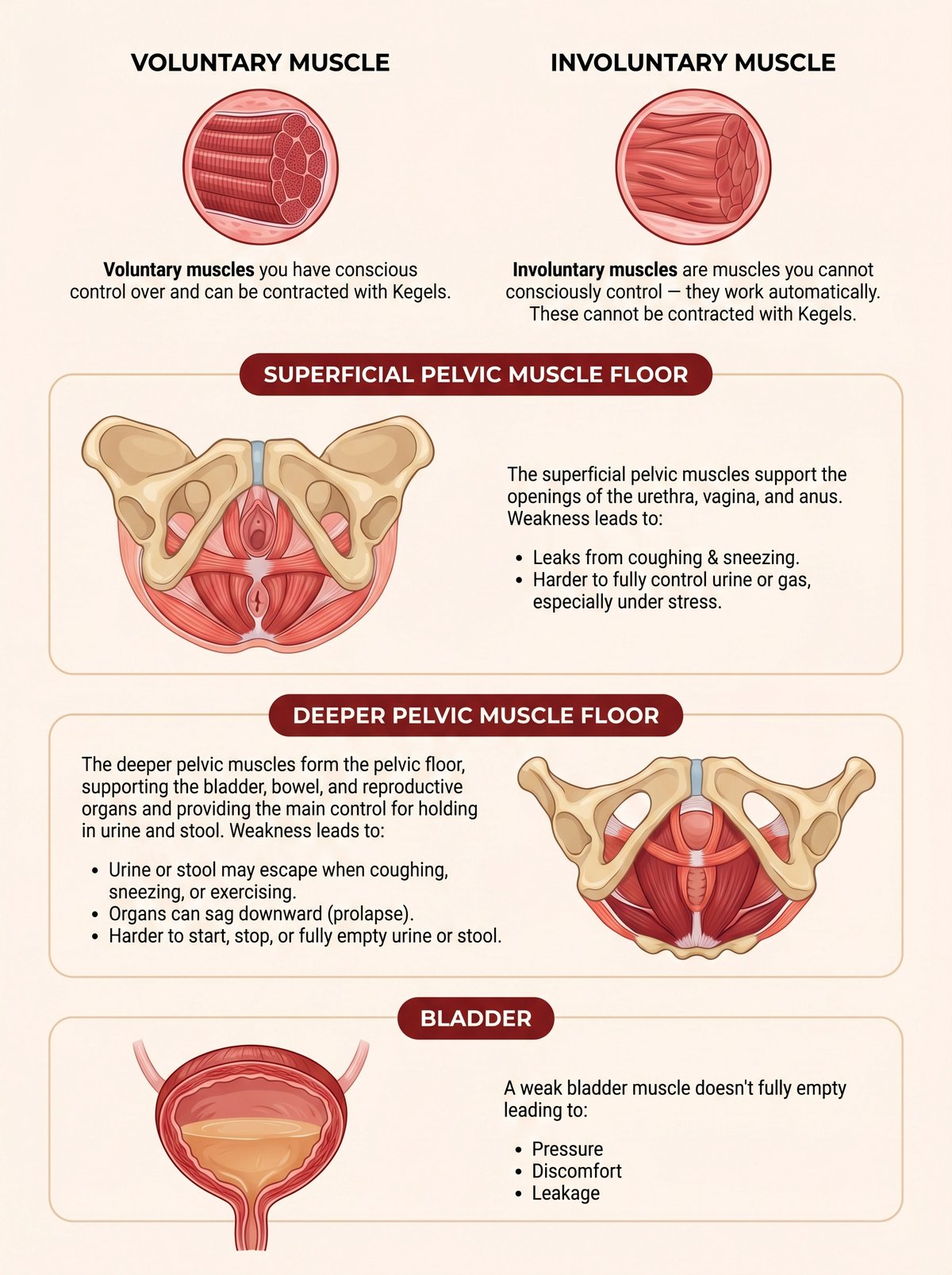
Across the base of your pelvis sit the muscles that hold your bladder, bowel and reproductive organs in place. They aren't one muscle. They're two layers, and they don't take orders the same way.
The superficial layer
Voluntary. This is the layer you can consciously squeeze. It supports the openings, and it's the only part a kegel actually reaches.
The deeper layer
Largely involuntary. This is the layer doing the real work of holding. It fires automatically, without you, which also means it does not respond when you tell it to. You cannot kegel a muscle you can't consciously contract.
When that deeper layer weakens, nothing dramatic happens. It just slowly gets harder to hold, harder to close, harder to brace. Which is exactly what leaking, urgency and heaviness actually are.
Why the kegels didn't work
It is not an effort problem.
It is an access problem.
You did them at red lights. You did them at your desk. You did them for months and quietly decided you must be doing them wrong.
You weren't.
You can squeeze the superficial layer all day. The deeper layer, the one carrying most of the load, doesn't answer to a conscious squeeze. It never did, for anyone.
Without feedback, it's common to tense the glutes, the abdomen or the inner thighs instead, and never know the difference.
Asking a muscle that has lost its signal to rebuild through repetition alone is like asking a phone with no service to make the call anyway.
Pads. Timed bathroom trips. Cutting out coffee. Pelvic floor exercises, again. None of it is wrong. None of it is a repair.
This is the part almost no one knows: there is now a way to reach those deeper muscles directly, without you having to find them, squeeze them, or remember to do anything at all.
This isn't something you caused
Almost every woman has at least two of these, stacked over a couple of decades.
Months of carrying weight on those muscles, then the delivery itself. Vaginal or cesarean, the load was there either way.
Falling estrogen thins and weakens the tissue that kept everything toned. This is why so many women say it got noticeably worse in their fifties.
Muscle mass declines everywhere after forty. The pelvic floor isn't exempt, and nobody's been training it.
Chronic coughing, constipation and straining, heavy lifting at work or at home. Small loads, thousands of times.
The honest answer
Because the money in this category has always been in management, not repair.
There is a multi-billion dollar industry built on pads and liners in discreet packaging, marketed to women as confidence and freedom. There are medications with side effects you then manage separately. There is surgery, which is real and sometimes right, and which most women are understandably not ready to consider for something they can technically live with.
And then there's the advice itself. "Do your kegels" costs nothing to give, takes ten seconds, and moves the appointment along. It isn't bad advice. It's just where the conversation has ended for most women, and it has been ending there for forty years.
Strengthening the pelvic floor without asking you to do the work yourself is genuinely newer, and it lives in clinics rather than in drugstore aisles. There's no television commercial for it. There's no aisle at Publix. So it spreads the slow way, one woman telling another.
That's the only reason you're reading about it for the first time today.
Find out where your pelvic floor actually stands, then decide.
What our team does differently
It's a chair. You sit in it, fully clothed, and the deeper pelvic floor muscles do thousands of contractions in a single session. Not something you have to learn, remember, or do correctly.
The half-second of tensing before a sneeze, a cough, a good laugh. That's the first thing most women notice going quiet.
No 3am trip. No wide-awake hour afterward trying to get back down.
The long drive. The class. The grandkids' trampoline. The extra pair of pants in the car, just in case.
How it actually works
Every muscle moves because a nerve tells it to. A kegel is you sending that message consciously, and by the time a woman is leaking, that message often isn't arriving with much force. The chair sends it for you: a focused electromagnetic field passes through clothing and skin, without heat and without touching the tissue, and stimulates the nerves that run the pelvic floor. Those nerves do what they've always done. They fire the muscles.
The difference is volume. In one session, seated, you get thousands of contractions at a depth voluntary effort doesn't reach. From there it's ordinary strength training. Muscle responds to load and repetition. The only thing that changed is who's doing the work.
| Kegels on your own | Sitting in the chair | |
|---|---|---|
| Which muscles get worked | Mostly the surface layer, if you're locating it correctly | The full pelvic floor, including the deep fibers |
| Contractions per session | Ten, maybe thirty, before fatigue | Thousands |
| What it asks of you | Remembering, daily, indefinitely | Showing up and sitting down |
Our team has been doing this with women across Tuscaloosa, Northport, McCalla and the surrounding communities. Most had never heard this existed before they walked in. Individual results vary, and our team will tell you honestly if they don't think you're a fit.
Let's take the mystery out of it
Most women picture something clinical and are relieved when they see it. It looks like a black armchair, because that's what it is.

No surprises
You should know the shape of the whole thing before you agree to the first part of it.
You sit down with our team. You go through your history, what's been happening and what you've already tried. You leave with a clear picture of where your pelvic floor stands today and an honest answer about whether this is a fit for you.
If it is a fit, our team maps out a short series over several weeks. Each visit is brief enough for a lunch break. You sit, fully clothed, and drive yourself back to work. There is nothing to do at home between visits.
Many women start noticing changes partway through the series, often with the sneeze or the 3am trip first. At the end, our team looks at where you are and talks with you about keeping it there. Individual results vary.
Before you book
We'd rather tell you now than take your time.
From women here in town
I didn't realize how much I'd rearranged my life around it until I stopped having to.
Tuscaloosa
I did the kegels for two years. Nobody ever told me there was anything else.
Northport
I sat in a chair and read. That was it. I kept waiting for the hard part.
McCalla
Individual results vary. Shared with permission.
Questions women ask us
No. Most women describe a steady tapping or pulsing sensation. It feels unfamiliar for about a minute and then becomes easy to ignore. Most women read or visit with our team straight through it.
It's non-invasive. There's no heat, no needles, nothing inserted and no recovery afterward. It isn't right for everyone, though, which is part of why our team reviews your history before anything else. Women who are pregnant or who have a pacemaker or implanted metal device aren't candidates.
Come as you are. Because the chair works with a magnetic field, our team will have you set your phone, your cards and anything metal on the side table, away from the chair, before you sit down. They walk you through it every time, so there's nothing for you to remember.
No. You stay fully clothed, including shoes. Come in whatever you were already wearing that day.
A kegel is a voluntary squeeze, and it mostly reaches the surface layer. This works the deeper muscles directly, without you having to locate or contract anything yourself. That's the whole difference, and it's why effort was never the missing piece.
It depends on where you're starting, which is exactly what the assessment establishes. Our team will walk you through what they'd recommend for you specifically before you commit to anything.
Women who've been managing this for decades are a large part of who we see. How long it's been going on matters less than what your muscles look like today, which is measurable.
No. Childbirth is one common cause. Age, menopause, prior surgery, chronic coughing and heavy lifting are others. Plenty of women we see have never been pregnant.
You didn't do anything wrong. You were given management tools for something that could be addressed. Find out where you actually stand, and then decide.